Events

Announcements

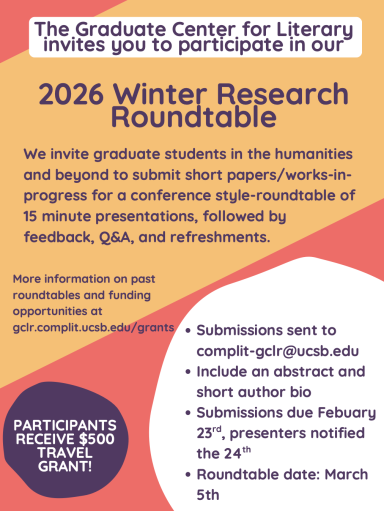
The Graduate Center for Literary Research is pleased to announce that we are currently accepting submissions for our Winter 2026 Research Roundtable, to be held on Thursday, March 5th in the GCLR seminar room (Phelps 6206C)!

Interested applicants are encouraged to submit short papers/works-in-progress for a presentation that will last around 15 minutes. Peers, invited faculty, facilitators, and fellow applicants can provide feedback, troubleshoot passages, and celebrate your progress. Following this, we will also have time for a Q&A session and a break with refreshments. Submissions can be directed to complit-gclr@ucsb.edu and should also include an abstract and short author bio. 

Rolling submission deadline closes on February 23rd. Selected presenters will be notified the following day. 

 
As a reminder, eligible participants are also eligible to win a $500 travel grant if a version of the paper they present is accepted to a professional academic conference! Each student is able to receive this grant up to two times in their graduate career at UCSB so even if you've presented at one of our roundtables before, we hope you'll apply again. 
 
This is an excellent opportunity for those preparing for an exam or conference, and can be listed as a grant won on your CV. 
 
Submissions and any other inquiries can be directed to complit-gclr@ucsb.edu


"Untimeliness, Emergency, Emergence"

Tuesday January 27, 2026 12:00 pm - 1:30 pm, Phelps 6206C

Lunch: Please RSVP here by Monday 1/26 - 12:00 pm

Nietzsche grounds his critique of the “consuming fever of history” upon the "untimely" character of Classical philology. The “untimely,” says Nietzsche, is what acts “counter to our time” and “on our time and, let us hope, for the benefit of a time to come.” In Contributions to Philosophy (of the Event), Martin Heidegger describes “the lack of a sense of emergency [Notlosigkeit] as the greatest emergency," pointing not to a call for immediate action, but instead, to a certain slowness of thinking. I will examine the life and afterlife of these two concepts and the friction that the socio-political present exerts upon them by putting them in dialogue with the work of the Venezuelan poet Igor Barreto (b. 1952). Barreto’s oeuvre interrogates, expands, and theorizes these concepts by exploring how environmental, non-human, and political agents localize our reflections on untimeliness and emergencia (emergency/emergence) within Venezuelan territory.

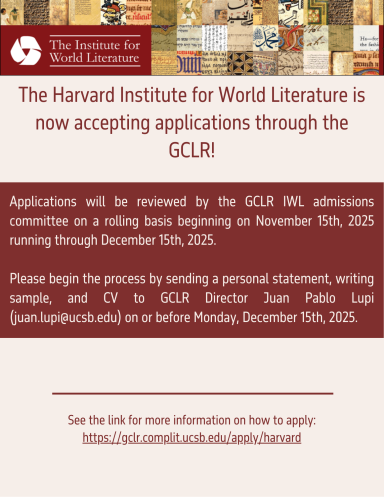
The Harvard Institute for World Literature is now accepting applications for its 2026 program through the GCLR! Please see the link (https://gclr.complit.ucsb.edu/apply/harvard) and attached flyer for more information. 
 

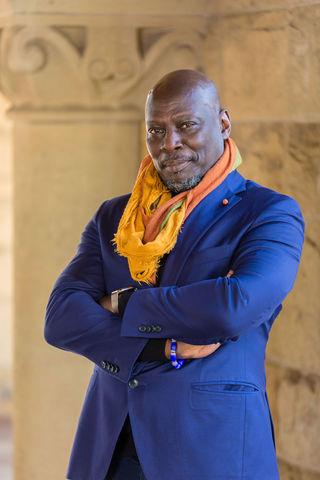
Please join us on Friday, May 16th from 4-6pm in the Wallis Annenberg Conference Room (SSMS 4315) for Prof. Ato Quayson's delivery of the 2025 GCLR Distinguished Guest Lecture. Prof. Quayson's talk is entitled "Interdisciplinarity and Interpretation: A Comparative Method" and you can find a brief description for it below. We hope to see many of you at this exciting event! 

Friends of the GCLR, 

Please join us on Thursday, May 15th from 1-3pm in Phelps 6206C for a seminar with Prof. Ato Quayson (English, Stanford), the GCLR's annual Distinguished Visiting Scholar!

You can RSVP for the event here.

Join us on Friday, May 23 from 2-3pm as Prof. Kevin B. Anderson, author of the acclaimed Marx at the Margins, presents his latest book entitled The Late Marx's Revolutionary Roads: Colonialism, Gender, Indigenous Communism. He will be joined in dialogue on these topics by Prof. Ricado Jacobs. A brief description of the book can be found below.

"In his late writings, Marx went beyond the boundaries of capital and class in the Western European and North American contexts. Kevin Anderson carries out a systematic analysis of Marx’s Ethnological Notebooks and related texts on Russia, India, Ireland, Algeria, Latin America, and ancient Rome. These texts, some of them only now being published, provide evidence for a change of perspective, away from Eurocentric worldviews or unilinear theories of development. As Anderson shows, the late Marx elaborated a truly global, multilinear theory of modern society and its revolutionary possibilities." 

Zoom attendance link here